I am a Ph.D. student in Physics at Dartmouth College.
My research lives at the intersection of theoretical and computational plasma physics, with a particular fascination for nonlinear phenomena inside turbulent plasmas. I am drawn to questions where mathematical elegance meets physical reality — where we can actually compute, visualize, and understand.
I am currently conducting research on the transport of cosmic rays in astrophysical contexts and energetic particles in fusion plasmas, under the supervision of Prof. Muni Zhou.
I grew up in Chongqing, a city of rolling hills, drifting fog, and warm, vivid spirit. Hanover has offered me something quite different: quiet atmosphere and long stretches of solitude that let my thoughts settle. Both the warmth and the calm are parts of how I do physics.
“Study hard what interests you the most in the most undisciplined, irreverent and original manner possible.”
Education
-
 Dartmouth CollegeDepartment of Physics & Astronomy
Ph.D. Student2026 - Expected 2031 -
 Huazhong University of Science and TechnologyB.S. in Physics2022 - 2026
Experience
-
State Key Laboratory of Advanced Electromagnetic Technology, International Joint Research Laboratory of Magnetic Confinement Fusion and Plasma Physics, School of Electrical and Electronic Engineering, HUSTResearch AssistantSep. 2023 - Jun. 2026
News
Selected Publications (view all )
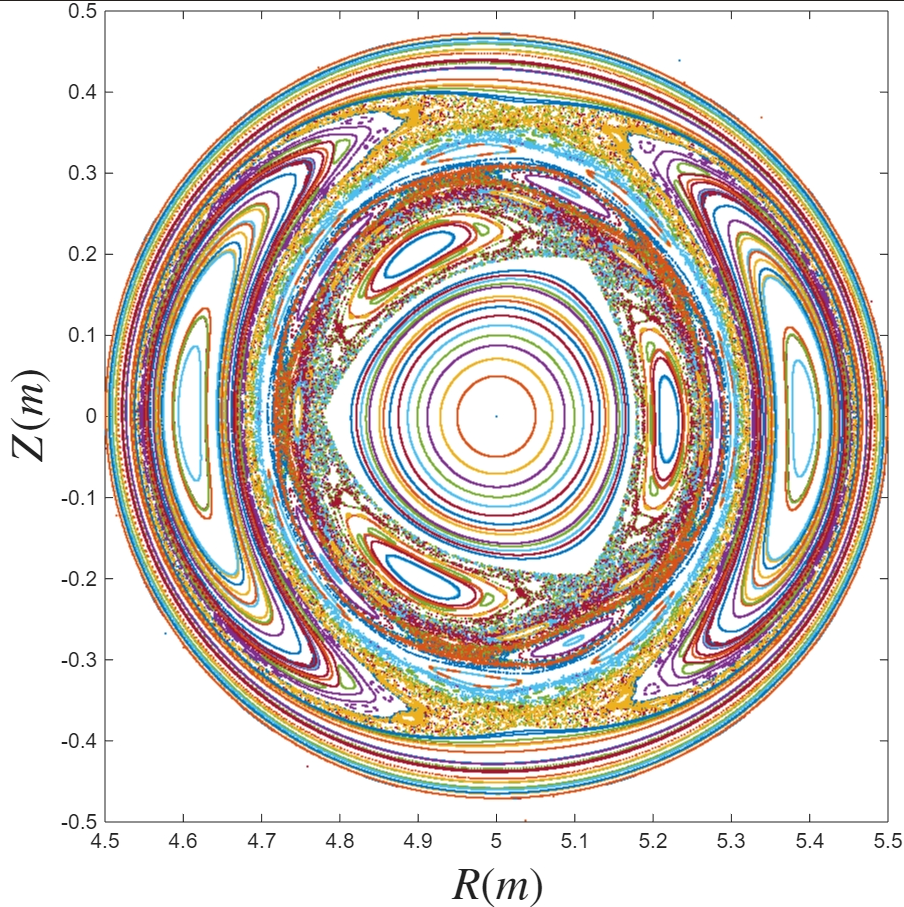
Hamiltonian estimation of island width threshold for stochasticity onset on edge pedestal top in the presence of a resonant magnetic perturbation
Z.-F. Gui, P. Zhu, D. F. Escande
Physics of Plasmas 2026
This study applies the Hamiltonian method to analyze the nonlinear magnetic topology induced by Resonant Magnetic Perturbations (RMPs) in tokamaks. We investigate the system's chaotic behavior by comparing three methods: the renormalization method, Lyapunov exponents, and weighted Birkhoff average. A strong consistency is found among these methods in predicting the large-scale stochasticity threshold. The magnetic island width threshold provides a quantitative criterion for optimizing RMP-based edge-localized modes control. Key contributions include a quantitative Hamiltonian renormalization criterion, cross-validation of multiple chaos diagnosis methods, experimentally verifiable benchmarks for RMP-based ELM control, and a mechanism for stochasticity triggered by edge MHD self-coupling.